


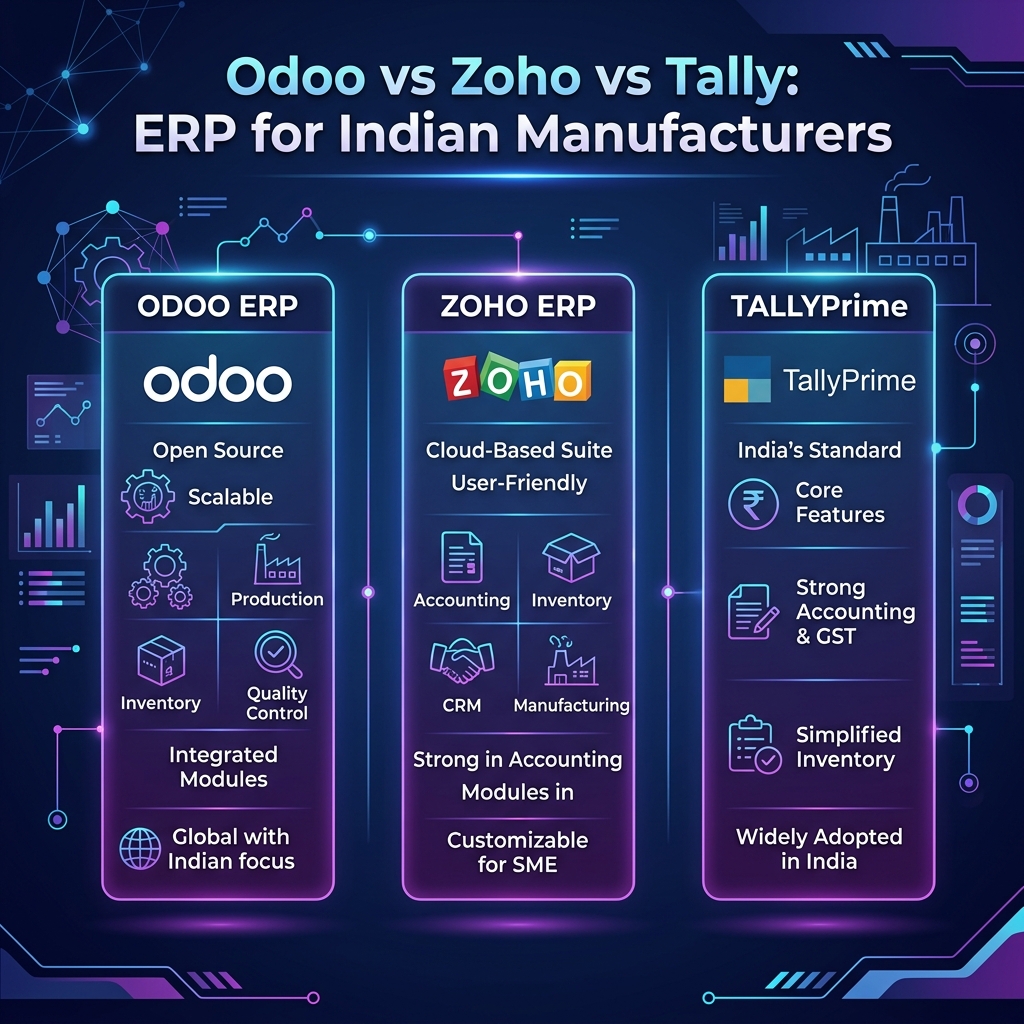
Choosing an ERP or business management system is an important decision for a growing manufacturing company in India.
In India, businesses commonly evaluate platforms such as Odoo, Zoho, and Tally. All three can support important business requirements, but they are designed around vastly different operational strengths.
The right choice depends less on which software is theoretically "best" and more on what your manufacturing business needs today—and where it is expected to be in the next few years.
| Requirement | Odoo | Zoho | Tally |
|---|---|---|---|
| Accounting | Strong | Strong | Strong |
| Sales Management | Strong | Strong | Basic to Moderate |
| CRM | Strong | Strong | Limited |
| Inventory | Strong | Strong | Accounting-Oriented |
| Manufacturing | Strong | Product/Workflow Dependent | Limited |
| Purchase Management | Strong | Strong | Available |
| Warehouse Operations | Strong | Good | Basic |
| Customization | High | Moderate to High | Limited for ERP |
| Integrated ERP Workflow | Strong | Ecosystem-Wide | Accounting-Focused |
| Best Fit | Growing & Complex Businesses | Connected SMB Apps | Accounting-Focused Businesses |
* The table above is a high-level comparison. Actual capabilities depend on the specific edition, applications, configuration, integrations, and implementation approach.
Tally has a long, established history in the Indian business environment and is widely recognized for accounting and financial management.
For a manufacturing company that primarily needs accounting, tax compliance (GST & TDS), invoicing, basic stock entries, and financial statements, Tally is a practical, cost-effective choice.
However, growing manufacturing companies frequently outgrow accounting-only tools. As operations scale, manufacturers require production planning, Bills of Materials (BOM), Manufacturing Orders, work center scheduling, quality control, maintenance tracking, and real-time operational dashboards. When these needs emerge, businesses begin evaluating enterprise ERP platforms.
Zoho offers a large ecosystem of cloud applications covering CRM, finance (Zoho Books), inventory, analytics, and business automation.
For small and medium-sized businesses, Zoho is attractive because companies can adopt modules as needed. A manufacturer might combine Zoho CRM, Zoho Books, Zoho Inventory, and Zoho Analytics. The primary consideration is evaluating how closely Zoho's available apps match multi-level manufacturing assembly processes compared to an all-in-one ERP.
Odoo takes a comprehensive ERP approach. Manufacturing companies can manage every operational node inside a single, unified database:
Sales Order → Manufacturing Requirement → Work Center Scheduling → Raw Material Consumption → Quality Inspection → Finished Goods Stock → Delivery → Financial Invoice
This seamless flow eliminates manual data re-entry, ensuring accurate margin tracking and stock availability.
Manufacturing complexity is often the single most critical deciding factor:
Every manufacturing company has unique shop-floor rules, multi-stage approval workflows, or specialized quality gates. Standard off-the-shelf software often requires companies to bend their processes to fit the software. Odoo provides a modular open architecture allowing custom module development, custom approval workflows, and specialized reporting tailored to unique production needs.
Easiest to deploy for financial accounting, invoicing, and basic ledger management.
Straightforward cloud setup for connected CRM, sales, and standard business apps.
Best for end-to-end manufacturing, multi-warehouse control, and shop-floor automation.
Evaluating software based solely on license price is a common mistake. True Total Cost of Ownership includes software licenses, implementation fees, custom development, data migration, employee training, and ongoing support.
A lower-cost standalone tool that requires multiple manual workarounds or duplicate data entries often proves far more expensive in hidden operational labor over time.
As your manufacturing footprint expands—adding production lines, multiple warehouses, branch distribution centers, and export sales—your ERP must scale without requiring a complete system replacement. Integrated platforms like Odoo allow you to activate new modules (like Maintenance, Quality, or eCommerce) seamlessly as your business matures.
Before committing to any software platform, document your actual workflows:
Need tailored Odoo ERP implementation or manufacturing solutions in Chennai OMR & India?
Explore ERP Services